"_We adopted the **FastAPI** library to spawn a **REST** server that can be queried to obtain **predictions**. [for Ludwig]_"
-<div style="text-align: right; margin-right: 10%;">Piero Molino, Yaroslav Dudin, and Sai Sumanth Miryala - <strong>Uber</strong> <a href="https://eng.uber.com/ludwig-v0-2/"><small>(ref)</small></a></div>
+<div style="text-align: right; margin-right: 10%;">Piero Molino, Yaroslav Dudin, and Sai Sumanth Miryala - <strong>Uber</strong> <a href="https://www.uber.com/us/en/blog/ludwig-v0-2/"><small>(ref)</small></a></div>
---
FastAPI stands on the shoulders of giants:
-* [Starlette](https://www.starlette.dev/) for the web parts.
-* [Pydantic](https://docs.pydantic.dev/) for the data parts.
+* [Starlette](https://starlette.dev/) for the web parts.
+* [Pydantic](https://pydantic.dev/docs/) for the data parts.
## Installation
<details markdown="1">
<summary>About the command <code>fastapi dev</code>...</summary>
-The command `fastapi dev` reads your `main.py` file automatically, detects the **FastAPI** app in it, and starts a server using [Uvicorn](https://www.uvicorn.dev).
+The command `fastapi dev` reads your `main.py` file automatically, detects the **FastAPI** app in it, and starts a server using [Uvicorn](https://uvicorn.dev).
By default, `fastapi dev` will start with auto-reload enabled for local development.
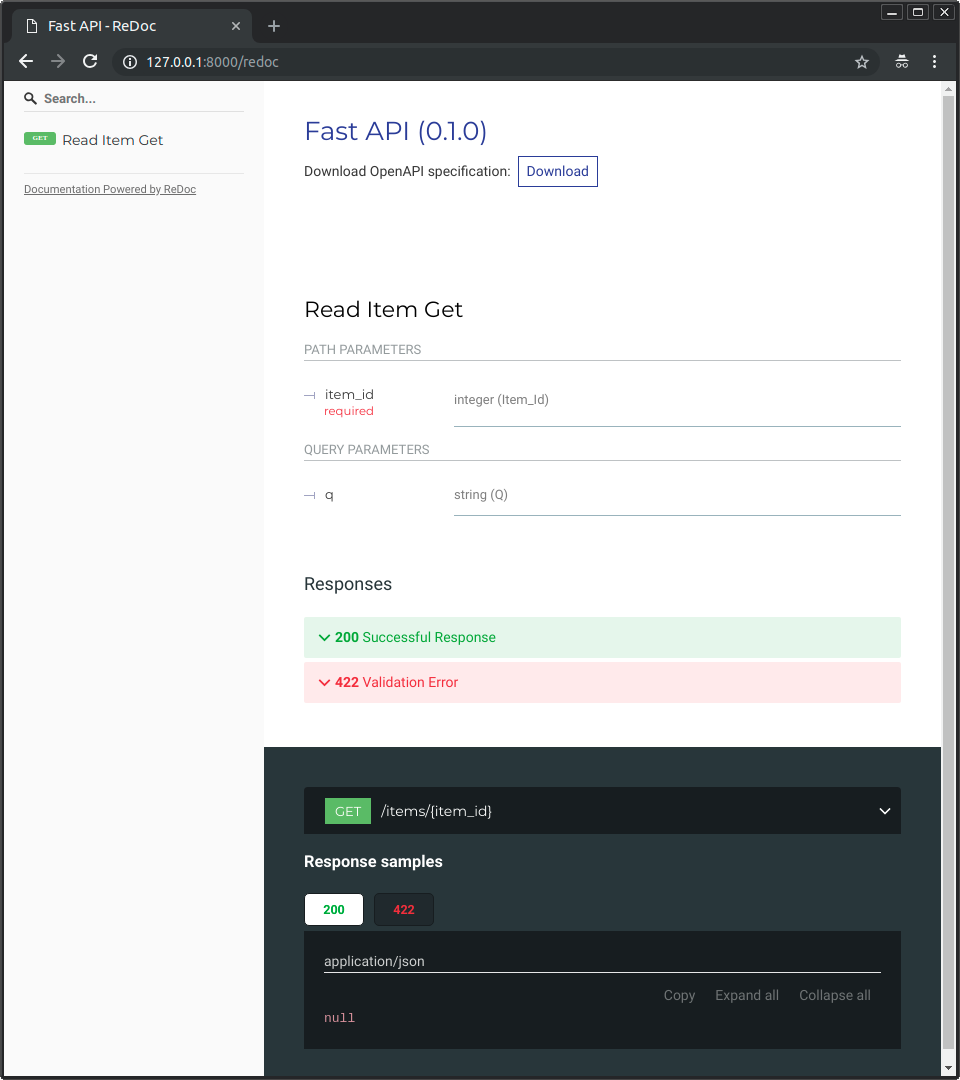
And now, go to [http://127.0.0.1:8000/redoc](http://127.0.0.1:8000/redoc).
-You will see the alternative automatic documentation (provided by [ReDoc](https://github.com/Rebilly/ReDoc)):
+You will see the alternative automatic documentation (provided by [ReDoc](https://github.com/Redocly/redoc)):
Used by FastAPI:
-* [`uvicorn`](https://www.uvicorn.dev) - for the server that loads and serves your application. This includes `uvicorn[standard]`, which includes some dependencies (e.g. `uvloop`) needed for high performance serving.
+* [`uvicorn`](https://uvicorn.dev) - for the server that loads and serves your application. This includes `uvicorn[standard]`, which includes some dependencies (e.g. `uvloop`) needed for high performance serving.
* `fastapi-cli[standard]` - to provide the `fastapi` command.
* This includes `fastapi-cloud-cli`, which allows you to deploy your FastAPI application to [FastAPI Cloud](https://fastapicloud.com).
Additional optional Pydantic dependencies:
-* [`pydantic-settings`](https://docs.pydantic.dev/latest/usage/pydantic_settings/) - for settings management.
-* [`pydantic-extra-types`](https://docs.pydantic.dev/latest/usage/types/extra_types/extra_types/) - for extra types to be used with Pydantic.
+* [`pydantic-settings`](https://pydantic.dev/docs/validation/latest/concepts/pydantic_settings/) - for settings management.
+* [`pydantic-extra-types`](https://github.com/pydantic/pydantic-extra-types) - for extra types to be used with Pydantic.
Additional optional FastAPI dependencies:
* [`orjson`](https://github.com/ijl/orjson) - Required if you want to use `ORJSONResponse`.
-* [`ujson`](https://github.com/esnme/ultrajson) - Required if you want to use `UJSONResponse`.
+* [`ujson`](https://github.com/ultrajson/ultrajson) - Required if you want to use `UJSONResponse`.
## License
# - url: https://testdriven.io/courses/tdd-fastapi/
# title: Learn to build high-quality web apps with best practices
# img: /img/sponsors/testdriven.svg
- - url: https://www.testmu.ai/?utm_source=fastapi&utm_medium=partner&utm_campaign=sponsor&utm_term=opensource&utm_content=webpage
+ - url: https://www.testmuai.com/?utm_source=fastapi&utm_medium=partner&utm_campaign=sponsor&utm_term=opensource&utm_content=webpage
title: TestMu AI. The Native AI-Agentic Cloud Platform to Supercharge Quality Engineering.
img: /img/sponsors/testmu.png
To see what exactly you can include in the responses, you can check these sections in the OpenAPI specification:
-* [OpenAPI Responses Object](https://github.com/OAI/OpenAPI-Specification/blob/master/versions/3.1.0.md#responses-object), it includes the `Response Object`.
-* [OpenAPI Response Object](https://github.com/OAI/OpenAPI-Specification/blob/master/versions/3.1.0.md#response-object), you can include anything from this directly in each response inside your `responses` parameter. Including `description`, `headers`, `content` (inside of this is that you declare different media types and JSON Schemas), and `links`.
+* [OpenAPI Responses Object](https://github.com/OAI/OpenAPI-Specification/blob/main/versions/3.1.0.md#responses-object), it includes the `Response Object`.
+* [OpenAPI Response Object](https://github.com/OAI/OpenAPI-Specification/blob/main/versions/3.1.0.md#response-object), you can include anything from this directly in each response inside your `responses` parameter. Including `description`, `headers`, `content` (inside of this is that you declare different media types and JSON Schemas), and `links`.
You can easily run the experiment locally with a stripped path prefix using [Traefik](https://docs.traefik.io/).
-[Download Traefik](https://github.com/containous/traefik/releases), it's a single binary, you can extract the compressed file and run it directly from the terminal.
+[Download Traefik](https://github.com/traefik/traefik/releases), it's a single binary, you can extract the compressed file and run it directly from the terminal.
Then create a file `traefik.toml` with:
{* ../../docs_src/dataclasses_/tutorial001_py310.py hl[1,6:11,18:19] *}
-This is still supported thanks to **Pydantic**, as it has [internal support for `dataclasses`](https://docs.pydantic.dev/latest/concepts/dataclasses/#use-of-stdlib-dataclasses-with-basemodel).
+This is still supported thanks to **Pydantic**, as it has [internal support for `dataclasses`](https://pydantic.dev/docs/validation/latest/concepts/dataclasses/#usage-of-stdlib-dataclasses-with-basemodel).
So, even with the code above that doesn't use Pydantic explicitly, FastAPI is using Pydantic to convert those standard dataclasses to Pydantic's own flavor of dataclasses.
You can also combine `dataclasses` with other Pydantic models, inherit from them, include them in your own models, etc.
-To learn more, check the [Pydantic docs about dataclasses](https://docs.pydantic.dev/latest/concepts/dataclasses/).
+To learn more, check the [Pydantic docs about dataclasses](https://pydantic.dev/docs/validation/latest/concepts/dataclasses/).
## Version { #version }
/// note
-You can read more about the Starlette `lifespan` handlers in [Starlette's Lifespan' docs](https://www.starlette.dev/lifespan/).
+You can read more about the Starlette `lifespan` handlers in [Starlette's Lifespan' docs](https://starlette.dev/lifespan/).
Including how to handle lifespan state that can be used in other areas of your code.
For **TypeScript clients**, [Hey API](https://heyapi.dev/) is a purpose-built solution, providing an optimized experience for the TypeScript ecosystem.
-You can discover more SDK generators on [OpenAPI.Tools](https://openapi.tools/#sdk).
+You can discover more SDK generators on [OpenAPI.Tools](https://openapi.tools/categories/sdk-generators).
/// tip
For example:
-* [Uvicorn's `ProxyHeadersMiddleware`](https://github.com/encode/uvicorn/blob/master/uvicorn/middleware/proxy_headers.py)
+* [Uvicorn's `ProxyHeadersMiddleware`](https://github.com/Kludex/uvicorn/blob/main/uvicorn/middleware/proxy_headers.py)
* [MessagePack](https://github.com/florimondmanca/msgpack-asgi)
-To see other available middlewares check [Starlette's Middleware docs](https://www.starlette.dev/middleware/) and the [ASGI Awesome List](https://github.com/florimondmanca/awesome-asgi).
+To see other available middlewares check [Starlette's Middleware docs](https://starlette.dev/middleware/) and the [ASGI Awesome List](https://github.com/florimondmanca/awesome-asgi).
/// tip
-The `callback_url` query parameter uses a Pydantic [Url](https://docs.pydantic.dev/latest/api/networks/) type.
+The `callback_url` query parameter uses a Pydantic [Url](https://pydantic.dev/docs/validation/latest/api/pydantic/networks/) type.
///
There are 2 main differences from a normal *path operation*:
* It doesn't need to have any actual code, because your app will never call this code. It's only used to document the *external API*. So, the function could just have `pass`.
-* The *path* can contain an [OpenAPI 3 expression](https://github.com/OAI/OpenAPI-Specification/blob/master/versions/3.1.0.md#key-expression) (see more below) where it can use variables with parameters and parts of the original request sent to *your API*.
+* The *path* can contain an [OpenAPI 3 expression](https://github.com/OAI/OpenAPI-Specification/blob/main/versions/3.1.0.md#key-expression) (see more below) where it can use variables with parameters and parts of the original request sent to *your API*.
### The callback path expression { #the-callback-path-expression }
-The callback *path* can have an [OpenAPI 3 expression](https://github.com/OAI/OpenAPI-Specification/blob/master/versions/3.1.0.md#key-expression) that can contain parts of the original request sent to *your API*.
+The callback *path* can have an [OpenAPI 3 expression](https://github.com/OAI/OpenAPI-Specification/blob/main/versions/3.1.0.md#key-expression) that can contain parts of the original request sent to *your API*.
In this case, it's the `str`:
///
-To see all the available parameters and options, check the [documentation in Starlette](https://www.starlette.dev/responses/#set-cookie).
+To see all the available parameters and options, check the [documentation in Starlette](https://starlette.dev/responses/#set-cookie).
Keep in mind that custom proprietary headers can be added [using the `X-` prefix](https://developer.mozilla.org/en-US/docs/Web/HTTP/Headers).
-But if you have custom headers that you want a client in a browser to be able to see, you need to add them to your CORS configurations (read more in [CORS (Cross-Origin Resource Sharing)](../tutorial/cors.md)), using the parameter `expose_headers` documented in [Starlette's CORS docs](https://www.starlette.dev/middleware/#corsmiddleware).
+But if you have custom headers that you want a client in a browser to be able to see, you need to add them to your CORS configurations (read more in [CORS (Cross-Origin Resource Sharing)](../tutorial/cors.md)), using the parameter `expose_headers` documented in [Starlette's CORS docs](https://starlette.dev/middleware/#corsmiddleware).
## Pydantic `Settings` { #pydantic-settings }
-Fortunately, Pydantic provides a great utility to handle these settings coming from environment variables with [Pydantic: Settings management](https://docs.pydantic.dev/latest/concepts/pydantic_settings/).
+Fortunately, Pydantic provides a great utility to handle these settings coming from environment variables with [Pydantic: Settings management](https://pydantic.dev/docs/validation/latest/concepts/pydantic_settings/).
### Install `pydantic-settings` { #install-pydantic-settings }
///
-Pydantic has support for reading from these types of files using an external library. You can read more at [Pydantic Settings: Dotenv (.env) support](https://docs.pydantic.dev/latest/concepts/pydantic_settings/#dotenv-env-support).
+Pydantic has support for reading from these types of files using an external library. You can read more at [Pydantic Settings: Dotenv (.env) support](https://pydantic.dev/docs/validation/latest/concepts/pydantic_settings/#dotenv-env-support).
/// tip
/// tip
-The `model_config` attribute is used just for Pydantic configuration. You can read more at [Pydantic: Concepts: Configuration](https://docs.pydantic.dev/latest/concepts/config/).
+The `model_config` attribute is used just for Pydantic configuration. You can read more at [Pydantic: Concepts: Configuration](https://pydantic.dev/docs/validation/latest/concepts/config/).
///
## More details { #more-details }
-For more details, including how to test templates, check [Starlette's docs on templates](https://www.starlette.dev/templates/).
+For more details, including how to test templates, check [Starlette's docs on templates](https://starlette.dev/templates/).
{* ../../docs_src/app_testing/tutorial004_py310.py hl[9:15,18,27:28,30:32,41:43] *}
-You can read more details about the ["Running lifespan in tests in the official Starlette documentation site."](https://www.starlette.dev/lifespan/#running-lifespan-in-tests)
+You can read more details about the ["Running lifespan in tests in the official Starlette documentation site."](https://starlette.dev/lifespan/#running-lifespan-in-tests)
For the deprecated `startup` and `shutdown` events, you can use the `TestClient` as follows:
/// note
-For more details, check Starlette's documentation for [testing WebSockets](https://www.starlette.dev/testclient/#testing-websocket-sessions).
+For more details, check Starlette's documentation for [testing WebSockets](https://starlette.dev/testclient/#testing-websocket-sessions).
///
## Details about the `Request` object { #details-about-the-request-object }
-As **FastAPI** is actually **Starlette** underneath, with a layer of several tools on top, you can use Starlette's [`Request`](https://www.starlette.dev/requests/) object directly when you need to.
+As **FastAPI** is actually **Starlette** underneath, with a layer of several tools on top, you can use Starlette's [`Request`](https://starlette.dev/requests/) object directly when you need to.
It would also mean that if you get data from the `Request` object directly (for example, read the body) it won't be validated, converted or documented (with OpenAPI, for the automatic API user interface) by FastAPI.
## `Request` documentation { #request-documentation }
-You can read more details about the [`Request` object in the official Starlette documentation site](https://www.starlette.dev/requests/).
+You can read more details about the [`Request` object in the official Starlette documentation site](https://starlette.dev/requests/).
/// note | Technical Details
To learn more about the options, check Starlette's documentation for:
-* [The `WebSocket` class](https://www.starlette.dev/websockets/).
-* [Class-based WebSocket handling](https://www.starlette.dev/endpoints/#websocketendpoint).
+* [The `WebSocket` class](https://starlette.dev/websockets/).
+* [Class-based WebSocket handling](https://starlette.dev/endpoints/#websocketendpoint).
And integrate standards-based user interface tools:
* [Swagger UI](https://github.com/swagger-api/swagger-ui)
-* [ReDoc](https://github.com/Rebilly/ReDoc)
+* [ReDoc](https://github.com/Redocly/redoc)
These two were chosen for being fairly popular and stable, but doing a quick search, you could find dozens of alternative user interfaces for OpenAPI (that you can use with **FastAPI**).
///
-### [NestJS](https://nestjs.com/) (and [Angular](https://angular.io/)) { #nestjs-and-angular }
+### [NestJS](https://nestjs.com/) (and [Angular](https://angular.dev/)) { #nestjs-and-angular }
This isn't even Python, NestJS is a JavaScript (TypeScript) NodeJS framework inspired by Angular.
/// note
-Hug was created by Timothy Crosley, the same creator of [`isort`](https://github.com/timothycrosley/isort), a great tool to automatically sort imports in Python files.
+Hug was created by Timothy Crosley, the same creator of [`isort`](https://github.com/PyCQA/isort), a great tool to automatically sort imports in Python files.
///
## Used by **FastAPI** { #used-by-fastapi }
-### [Pydantic](https://docs.pydantic.dev/) { #pydantic }
+### [Pydantic](https://pydantic.dev/docs/) { #pydantic }
Pydantic is a library to define data validation, serialization and documentation (using JSON Schema) based on Python type hints.
///
-### [Starlette](https://www.starlette.dev/) { #starlette }
+### [Starlette](https://starlette.dev/) { #starlette }
Starlette is a lightweight <dfn title="The new standard for building asynchronous Python web applications">ASGI</dfn> framework/toolkit, which is ideal for building high-performance asyncio services.
///
-### [Uvicorn](https://www.uvicorn.dev/) { #uvicorn }
+### [Uvicorn](https://uvicorn.dev) { #uvicorn }
Uvicorn is a lightning-fast ASGI server, built on uvloop and httptools.
And you can also go to [http://192.168.99.100/redoc](http://192.168.99.100/redoc) or [http://127.0.0.1/redoc](http://127.0.0.1/redoc) (or equivalent, using your Docker host).
-You will see the alternative automatic documentation (provided by [ReDoc](https://github.com/Rebilly/ReDoc)):
+You will see the alternative automatic documentation (provided by [ReDoc](https://github.com/Redocly/redoc)):

There are several alternatives, including:
-* [Uvicorn](https://www.uvicorn.dev/): a high performance ASGI server.
+* [Uvicorn](https://uvicorn.dev): a high performance ASGI server.
* [Hypercorn](https://hypercorn.readthedocs.io/): an ASGI server compatible with HTTP/2 and Trio among other features.
* [Daphne](https://github.com/django/daphne): the ASGI server built for Django Channels.
* [Granian](https://github.com/emmett-framework/granian): A Rust HTTP server for Python applications.
///
-Internally, **FastAPI CLI** uses [Uvicorn](https://www.uvicorn.dev), a high-performance, production-ready, ASGI server. 😎
+Internally, **FastAPI CLI** uses [Uvicorn](https://uvicorn.dev), a high-performance, production-ready, ASGI server. 😎
The `fastapi` CLI will try to detect automatically the FastAPI app to run, assuming it's an object called `app` in a file `main.py` (or a couple other variants).
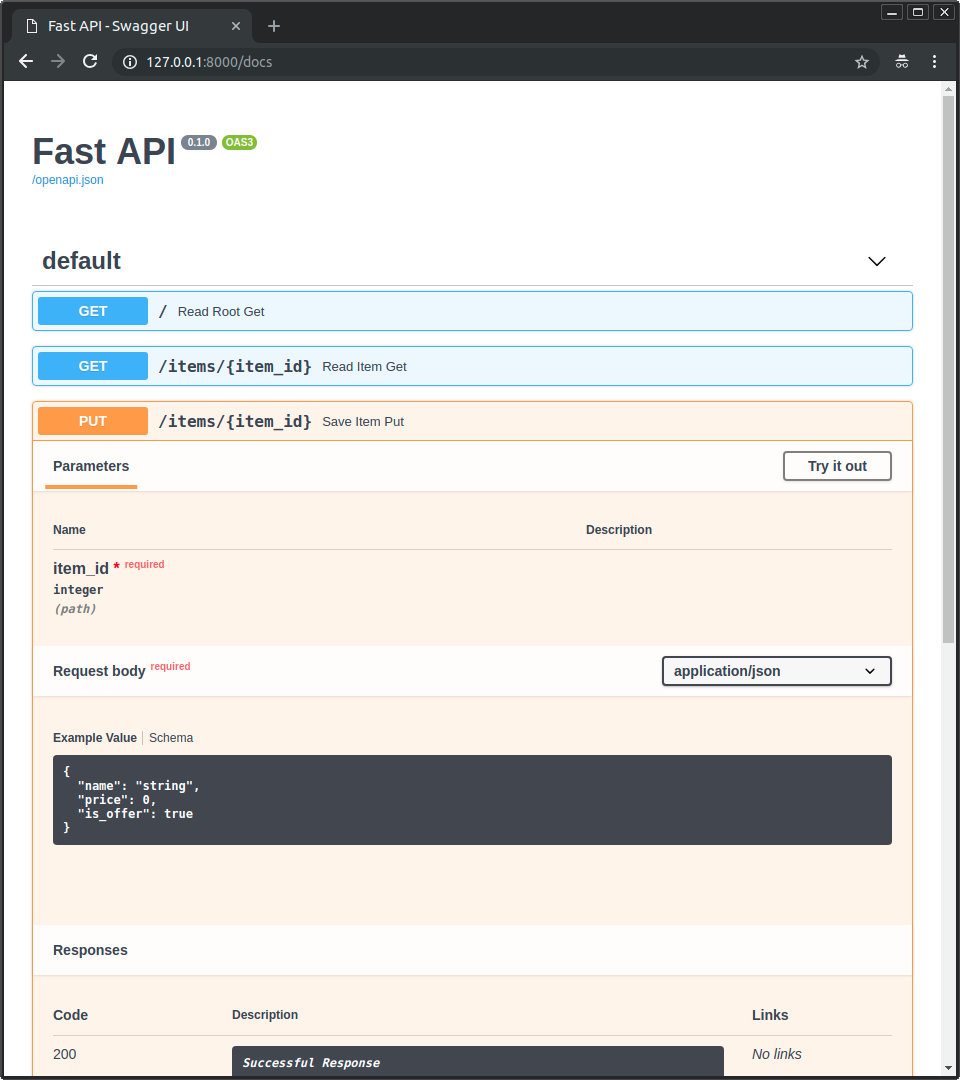
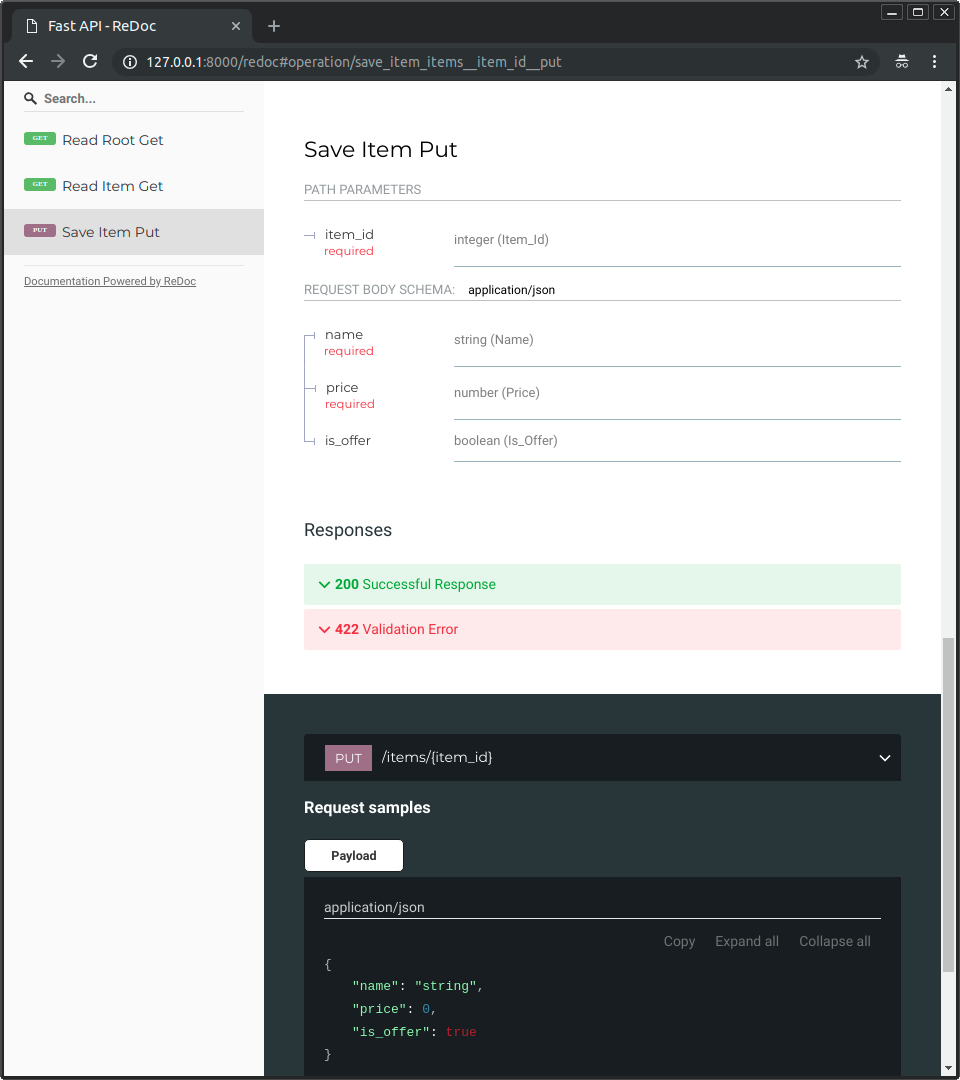
-* Alternative API documentation with [**ReDoc**](https://github.com/Rebilly/ReDoc).
+* Alternative API documentation with [**ReDoc**](https://github.com/Redocly/redoc).
## Starlette features { #starlette-features }
-**FastAPI** is fully compatible with (and based on) [**Starlette**](https://www.starlette.dev/). So, any additional Starlette code you have, will also work.
+**FastAPI** is fully compatible with (and based on) [**Starlette**](https://starlette.dev/). So, any additional Starlette code you have, will also work.
`FastAPI` is actually a sub-class of `Starlette`. So, if you already know or use Starlette, most of the functionality will work the same way.
## Pydantic features { #pydantic-features }
-**FastAPI** is fully compatible with (and based on) [**Pydantic**](https://docs.pydantic.dev/). So, any additional Pydantic code you have, will also work.
+**FastAPI** is fully compatible with (and based on) [**Pydantic**](https://pydantic.dev/docs/). So, any additional Pydantic code you have, will also work.
Including external libraries also based on Pydantic, such as <abbr title="Object-Relational Mapper">ORM</abbr>s and <abbr title="Object-Document Mapper">ODM</abbr>s for databases.
## Join the Chat { #join-the-chat }
-Join the 👥 [Discord chat server](https://discord.gg/VQjSZaeJmf) 👥 and hang out with others in the FastAPI community.
+Join the 👥 [Discord chat server](https://discord.com/invite/VQjSZaeJmf) 👥 and hang out with others in the FastAPI community.
/// tip
## Requirements { #requirements }
-After testing several alternatives, I decided that I was going to use [**Pydantic**](https://docs.pydantic.dev/) for its advantages.
+After testing several alternatives, I decided that I was going to use [**Pydantic**](https://pydantic.dev/docs/) for its advantages.
Then I contributed to it, to make it fully compliant with JSON Schema, to support different ways to define constraint declarations, and to improve editor support (type checks, autocompletion) based on the tests in several editors.
-During the development, I also contributed to [**Starlette**](https://www.starlette.dev/), the other key requirement.
+During the development, I also contributed to [**Starlette**](https://starlette.dev/), the other key requirement.
## Development { #development }
And those two things, `scope` and `receive`, are what is needed to create a new `Request` instance.
-To learn more about the `Request` check [Starlette's docs about Requests](https://www.starlette.dev/requests/).
+To learn more about the `Request` check [Starlette's docs about Requests](https://starlette.dev/requests/).
///
Using the information above, you can use the same utility function to generate the OpenAPI schema and override each part that you need.
-For example, let's add [ReDoc's OpenAPI extension to include a custom logo](https://github.com/Rebilly/ReDoc/blob/master/docs/redoc-vendor-extensions.md#x-logo).
+For example, let's add [ReDoc's OpenAPI extension to include a custom logo](https://github.com/Redocly/redoc/blob/main/docs/redoc-vendor-extensions.md#x-logo).
### Normal **FastAPI** { #normal-fastapi }
* [Strawberry](https://strawberry.rocks/) 🍓
* With [docs for FastAPI](https://strawberry.rocks/docs/integrations/fastapi)
* [Ariadne](https://ariadnegraphql.org/)
- * With [docs for FastAPI](https://ariadnegraphql.org/docs/fastapi-integration)
+ * With [docs for FastAPI](https://ariadnegraphql.org/server/Integrations/fastapi-integration)
* [Tartiflette](https://tartiflette.io/)
* With [Tartiflette ASGI](https://tartiflette.github.io/tartiflette-asgi/) to provide ASGI integration
* [Graphene](https://graphene-python.org/)
## Official Guide { #official-guide }
-Pydantic has an official [Migration Guide](https://docs.pydantic.dev/latest/migration/) from v1 to v2.
+Pydantic has an official [Migration Guide](https://pydantic.dev/docs/validation/latest/get-started/migration/) from v1 to v2.
It also includes what has changed, how validations are now more correct and strict, possible caveats, etc.
</div>
<div class="fastapi-opinions__panel" id="fo-panel-uber" role="tabpanel" aria-labelledby="fo-tab-uber" tabindex="0" hidden>
<blockquote class="fastapi-opinions__quote">"We adopted the <strong>FastAPI</strong> library to spawn a <strong>REST</strong> server that can be queried to obtain <strong>predictions</strong>." <em>[for Ludwig]</em></blockquote>
- <div class="fastapi-opinions__attr">— Piero Molino, Yaroslav Dudin, Sai Sumanth Miryala, <strong>Uber</strong> <a href="https://eng.uber.com/ludwig-v0-2/">(ref)</a></div>
+ <div class="fastapi-opinions__attr">— Piero Molino, Yaroslav Dudin, Sai Sumanth Miryala, <strong>Uber</strong> <a href="https://www.uber.com/us/en/blog/ludwig-v0-2/">(ref)</a></div>
</div>
<div class="fastapi-opinions__panel" id="fo-panel-netflix" role="tabpanel" aria-labelledby="fo-tab-netflix" tabindex="0" hidden>
<blockquote class="fastapi-opinions__quote">"<strong>Netflix</strong> is pleased to announce the open-source release of our <strong>crisis management</strong> orchestration framework: <strong>Dispatch</strong>!" <em>[built with FastAPI]</em></blockquote>
"_We adopted the **FastAPI** library to spawn a **REST** server that can be queried to obtain **predictions**. [for Ludwig]_"
-<div style="text-align: right; margin-right: 10%;">Piero Molino, Yaroslav Dudin, and Sai Sumanth Miryala - <strong>Uber</strong> <a href="https://eng.uber.com/ludwig-v0-2/"><small>(ref)</small></a></div>
+<div style="text-align: right; margin-right: 10%;">Piero Molino, Yaroslav Dudin, and Sai Sumanth Miryala - <strong>Uber</strong> <a href="https://www.uber.com/us/en/blog/ludwig-v0-2/"><small>(ref)</small></a></div>
---
FastAPI stands on the shoulders of giants:
-* [Starlette](https://www.starlette.dev/) for the web parts.
-* [Pydantic](https://docs.pydantic.dev/) for the data parts.
+* [Starlette](https://starlette.dev/) for the web parts.
+* [Pydantic](https://pydantic.dev/docs/) for the data parts.
## Installation { #installation }
<details markdown="1">
<summary>About the command <code>fastapi dev</code>...</summary>
-The command `fastapi dev` reads your `main.py` file automatically, detects the **FastAPI** app in it, and starts a server using [Uvicorn](https://www.uvicorn.dev).
+The command `fastapi dev` reads your `main.py` file automatically, detects the **FastAPI** app in it, and starts a server using [Uvicorn](https://uvicorn.dev).
By default, `fastapi dev` will start with auto-reload enabled for local development.
And now, go to [http://127.0.0.1:8000/redoc](http://127.0.0.1:8000/redoc).
-You will see the alternative automatic documentation (provided by [ReDoc](https://github.com/Rebilly/ReDoc)):
+You will see the alternative automatic documentation (provided by [ReDoc](https://github.com/Redocly/redoc)):

Used by FastAPI:
-* [`uvicorn`](https://www.uvicorn.dev) - for the server that loads and serves your application. This includes `uvicorn[standard]`, which includes some dependencies (e.g. `uvloop`) needed for high performance serving.
+* [`uvicorn`](https://uvicorn.dev) - for the server that loads and serves your application. This includes `uvicorn[standard]`, which includes some dependencies (e.g. `uvloop`) needed for high performance serving.
* `fastapi-cli[standard]` - to provide the `fastapi` command.
* This includes `fastapi-cloud-cli`, which allows you to deploy your FastAPI application to [FastAPI Cloud](https://fastapicloud.com).
Additional optional Pydantic dependencies:
-* [`pydantic-settings`](https://docs.pydantic.dev/latest/usage/pydantic_settings/) - for settings management.
-* [`pydantic-extra-types`](https://docs.pydantic.dev/latest/usage/types/extra_types/extra_types/) - for extra types to be used with Pydantic.
+* [`pydantic-settings`](https://pydantic.dev/docs/validation/latest/concepts/pydantic_settings/) - for settings management.
+* [`pydantic-extra-types`](https://github.com/pydantic/pydantic-extra-types) - for extra types to be used with Pydantic.
Additional optional FastAPI dependencies:
* [`orjson`](https://github.com/ijl/orjson) - Required if you want to use `ORJSONResponse`.
-* [`ujson`](https://github.com/esnme/ultrajson) - Required if you want to use `UJSONResponse`.
+* [`ujson`](https://github.com/ultrajson/ultrajson) - Required if you want to use `UJSONResponse`.
## License { #license }
You can use this template to get started, as it includes a lot of the initial setup, security, database and some API endpoints already done for you.
-GitHub Repository: [Full Stack FastAPI Template](https://github.com/tiangolo/full-stack-fastapi-template)
+GitHub Repository: [Full Stack FastAPI Template](https://github.com/fastapi/full-stack-fastapi-template)
## Full Stack FastAPI Template - Technology Stack and Features { #full-stack-fastapi-template-technology-stack-and-features }
- ⚡ [**FastAPI**](https://fastapi.tiangolo.com) for the Python backend API.
- 🧰 [SQLModel](https://sqlmodel.tiangolo.com) for the Python SQL database interactions (ORM).
- - 🔍 [Pydantic](https://docs.pydantic.dev), used by FastAPI, for the data validation and settings management.
+ - 🔍 [Pydantic](https://pydantic.dev/docs/), used by FastAPI, for the data validation and settings management.
- 💾 [PostgreSQL](https://www.postgresql.org) as the SQL database.
- 🚀 [React](https://react.dev) for the frontend.
- 💃 Using TypeScript, hooks, Vite, and other parts of a modern frontend stack.
## Pydantic models { #pydantic-models }
-[Pydantic](https://docs.pydantic.dev/) is a Python library to perform data validation.
+[Pydantic](https://pydantic.dev/docs/) is a Python library to perform data validation.
You declare the "shape" of the data as classes with attributes.
/// note
-To learn more about [Pydantic, check its docs](https://docs.pydantic.dev/).
+To learn more about [Pydantic, check its docs](https://pydantic.dev/docs/).
///
* The attribute `schema_extra` for the internal class `Config` has been replaced by the key `json_schema_extra` in the new `model_config` dict.
* You can read more about it in the docs for [Declare Request Example Data](https://fastapi.tiangolo.com/tutorial/schema-extra-example/).
* When you install `"fastapi[all]"` it now also includes:
- * [`pydantic-settings`](https://docs.pydantic.dev/latest/usage/pydantic_settings/) - for settings management.
+ * [`pydantic-settings`](https://pydantic.dev/docs/validation/latest/concepts/pydantic_settings/) - for settings management.
* [`pydantic-extra-types`](https://docs.pydantic.dev/latest/usage/types/extra_types/extra_types/) - for extra types to be used with Pydantic.
* Now Pydantic Settings is an additional optional package (included in `"fastapi[all]"`). To use settings you should now import `from pydantic_settings import BaseSettings` instead of importing from `pydantic` directly.
* You can read more about it in the docs for [Settings and Environment Variables](https://fastapi.tiangolo.com/advanced/settings/).
* Upgrade the compatible version of Starlette to `0.12.0`.
* This includes support for ASGI 3 (the latest version of the standard).
- * It's now possible to use [Starlette's `StreamingResponse`](https://www.starlette.dev/responses/#streamingresponse) with iterators, like [file-like](https://docs.python.org/3/glossary.html#term-file-like-object) objects (as those returned by `open()`).
+ * It's now possible to use [Starlette's `StreamingResponse`](https://starlette.dev/responses/#streamingresponse) with iterators, like [file-like](https://docs.python.org/3/glossary.html#term-file-like-object) objects (as those returned by `open()`).
* It's now possible to use the low level utility `iterate_in_threadpool` from `starlette.concurrency` (for advanced scenarios).
* PR [#243](https://github.com/tiangolo/fastapi/pull/243).
## Technical Details { #technical-details }
-The class `BackgroundTasks` comes directly from [`starlette.background`](https://www.starlette.dev/background/).
+The class `BackgroundTasks` comes directly from [`starlette.background`](https://starlette.dev/background/).
It is imported/included directly into FastAPI so that you can import it from `fastapi` and avoid accidentally importing the alternative `BackgroundTask` (without the `s` at the end) from `starlette.background`.
It's still possible to use `BackgroundTask` alone in FastAPI, but you have to create the object in your code and return a Starlette `Response` including it.
-You can see more details in [Starlette's official docs for Background Tasks](https://www.starlette.dev/background/).
+You can see more details in [Starlette's official docs for Background Tasks](https://starlette.dev/background/).
## Caveat { #caveat }
Apart from normal singular types like `str`, `int`, `float`, etc. you can use more complex singular types that inherit from `str`.
-To see all the options you have, check out [Pydantic's Type Overview](https://docs.pydantic.dev/latest/concepts/types/). You will see some examples in the next chapter.
+To see all the options you have, check out [Pydantic's Type Overview](https://pydantic.dev/docs/validation/latest/concepts/types/). You will see some examples in the next chapter.
For example, as in the `Image` model we have a `url` field, we can declare it to be an instance of Pydantic's `HttpUrl` instead of a `str`:
Your API almost always has to send a **response** body. But clients don't necessarily need to send **request bodies** all the time, sometimes they only request a path, maybe with some query parameters, but don't send a body.
-To declare a **request** body, you use [Pydantic](https://docs.pydantic.dev/) models with all their power and benefits.
+To declare a **request** body, you use [Pydantic](https://pydantic.dev/docs/) models with all their power and benefits.
/// note
* `datetime.timedelta`:
* A Python `datetime.timedelta`.
* In requests and responses will be represented as a `float` of total seconds.
- * Pydantic also allows representing it as an "ISO 8601 time diff encoding", [see the docs for more info](https://docs.pydantic.dev/latest/concepts/serialization/#custom-serializers).
+ * Pydantic also allows representing it as an "ISO 8601 time diff encoding", [see the docs for more info](https://pydantic.dev/docs/validation/latest/concepts/serialization/#custom-serializers).
* `frozenset`:
* In requests and responses, treated the same as a `set`:
* In requests, a list will be read, eliminating duplicates and converting it to a `set`.
* `Decimal`:
* Standard Python `Decimal`.
* In requests and responses, handled the same as a `float`.
-* You can check all the valid Pydantic data types here: [Pydantic data types](https://docs.pydantic.dev/latest/usage/types/types/).
+* You can check all the valid Pydantic data types here: [Pydantic data types](https://pydantic.dev/docs/validation/latest/concepts/types/).
## Example { #example }
/// note
-When defining a [`Union`](https://docs.pydantic.dev/latest/concepts/types/#unions), include the most specific type first, followed by the less specific type. In the example below, the more specific `PlaneItem` comes before `CarItem` in `Union[PlaneItem, CarItem]`.
+When defining a [`Union`](https://pydantic.dev/docs/validation/latest/concepts/unions/), include the most specific type first, followed by the less specific type. In the example below, the more specific `PlaneItem` comes before `CarItem` in `Union[PlaneItem, CarItem]`.
///
And now, go to [http://127.0.0.1:8000/redoc](http://127.0.0.1:8000/redoc).
-You will see the alternative automatic documentation (provided by [ReDoc](https://github.com/Rebilly/ReDoc)):
+You will see the alternative automatic documentation (provided by [ReDoc](https://github.com/Redocly/redoc)):

`FastAPI` is a class that inherits directly from `Starlette`.
-You can use all the [Starlette](https://www.starlette.dev/) functionality with `FastAPI` too.
+You can use all the [Starlette](https://starlette.dev/) functionality with `FastAPI` too.
///
## Install custom exception handlers { #install-custom-exception-handlers }
-You can add custom exception handlers with [the same exception utilities from Starlette](https://www.starlette.dev/exceptions/).
+You can add custom exception handlers with [the same exception utilities from Starlette](https://starlette.dev/exceptions/).
Let's say you have a custom exception `UnicornException` that you (or a library you use) might `raise`.
Keep in mind that custom proprietary headers can be added [using the `X-` prefix](https://developer.mozilla.org/en-US/docs/Web/HTTP/Headers).
-But if you have custom headers that you want a client in a browser to be able to see, you need to add them to your CORS configurations ([CORS (Cross-Origin Resource Sharing)](cors.md)) using the parameter `expose_headers` documented in [Starlette's CORS docs](https://www.starlette.dev/middleware/#corsmiddleware).
+But if you have custom headers that you want a client in a browser to be able to see, you need to add them to your CORS configurations ([CORS (Cross-Origin Resource Sharing)](cors.md)) using the parameter `expose_headers` documented in [Starlette's CORS docs](https://starlette.dev/middleware/#corsmiddleware).
///
## Standards-based benefits, alternative documentation { #standards-based-benefits-alternative-documentation }
-And because the generated schema is from the [OpenAPI](https://github.com/OAI/OpenAPI-Specification/blob/master/versions/3.1.0.md) standard, there are many compatible tools.
+And because the generated schema is from the [OpenAPI](https://github.com/OAI/OpenAPI-Specification/blob/main/versions/3.1.0.md) standard, there are many compatible tools.
Because of this, **FastAPI** itself provides an alternative API documentation (using ReDoc), which you can access at [http://127.0.0.1:8000/redoc](http://127.0.0.1:8000/redoc):
## Pydantic { #pydantic }
-All the data validation is performed under the hood by [Pydantic](https://docs.pydantic.dev/), so you get all the benefits from it. And you know you are in good hands.
+All the data validation is performed under the hood by [Pydantic](https://pydantic.dev/docs/), so you get all the benefits from it. And you know you are in good hands.
You can use the same type declarations with `str`, `float`, `bool` and many other complex data types.
In those cases, you can use a **custom validator function** that is applied after the normal validation (e.g. after validating that the value is a `str`).
-You can achieve that using [Pydantic's `AfterValidator`](https://docs.pydantic.dev/latest/concepts/validators/#field-after-validator) inside of `Annotated`.
+You can achieve that using [Pydantic's `AfterValidator`](https://pydantic.dev/docs/validation/latest/concepts/validators/#field-after-validator) inside of `Annotated`.
/// tip
-Pydantic also has [`BeforeValidator`](https://docs.pydantic.dev/latest/concepts/validators/#field-before-validator) and others. 🤓
+Pydantic also has [`BeforeValidator`](https://pydantic.dev/docs/validation/latest/concepts/validators/#field-before-validator) and others. 🤓
///
* `response_model_exclude_defaults=True`
* `response_model_exclude_none=True`
-as described in [the Pydantic docs](https://docs.pydantic.dev/1.10/usage/exporting_models/#modeldict) for `exclude_defaults` and `exclude_none`.
+as described in [the Pydantic docs](https://pydantic.dev/docs/validation/latest/concepts/serialization/#excluding-and-including-fields-based-on-their-value) for `exclude_defaults` and `exclude_none`.
///
That extra info will be added as-is to the output **JSON Schema** for that model, and it will be used in the API docs.
-You can use the attribute `model_config` that takes a `dict` as described in [Pydantic's docs: Configuration](https://docs.pydantic.dev/latest/api/config/).
+You can use the attribute `model_config` that takes a `dict` as described in [Pydantic's docs: Configuration](https://pydantic.dev/docs/validation/latest/api/pydantic/config/).
You can set `"json_schema_extra"` with a `dict` containing any additional data you would like to show up in the generated JSON Schema, including `examples`.
## More info { #more-info }
-For more details and options check [Starlette's docs about Static Files](https://www.starlette.dev/staticfiles/).
+For more details and options check [Starlette's docs about Static Files](https://starlette.dev/staticfiles/).
# Testing { #testing }
-Thanks to [Starlette](https://www.starlette.dev/testclient/), testing **FastAPI** applications is easy and enjoyable.
+Thanks to [Starlette](https://starlette.dev/testclient/), testing **FastAPI** applications is easy and enjoyable.
It is based on [HTTPX](https://www.python-httpx.org), which in turn is designed based on Requests, so it's very familiar and intuitive.
- icon: octicons/mark-github-24
link: https://github.com/fastapi/fastapi
- icon: fontawesome/brands/discord
- link: https://discord.gg/VQjSZaeJmf
+ link: https://discord.com/invite/VQjSZaeJmf
- icon: fontawesome/brands/x-twitter
link: https://x.com/fastapi
- icon: fontawesome/brands/bluesky
errors.
Read more in the
- [Starlette docs for Applications](https://www.starlette.dev/applications/#instantiating-the-application).
+ [Starlette docs for Applications](https://starlette.dev/applications/#starlette.applications.Starlette).
"""
),
] = False,
This is simply inherited from Starlette.
Read more about it in the
- [Starlette docs for Applications](https://www.starlette.dev/applications/#storing-state-on-the-app-instance).
+ [Starlette docs for Applications](https://starlette.dev/applications/#storing-state-on-the-app-instance).
"""
),
] = State()
 projects / thirdparty / fastapi / fastapi.git / commitdiff

